




Maryland Now Allows TOD Beneficiaries on Boats and Joint Vehicles!
A common scenario in Maryland up until now involves a family did their planning well: the house passes by deed, the retirement accounts and life insurance have beneficiaries, the bank accounts are payable on death. Then someone finds the title to Dad’s pickup truck, or the boat he kept at Deep Creek or on the Chesapeake, and it turns out that one asset forces the family to open an estate with the Register of Wills anyway.
Maryland has been steadily closing that gap. Since 2022, a sole owner of a vehicle has been able to name a transfer-on-death (TOD) beneficiary on the title. And effective October 1, 2026, a new law (SB 145/HB 174, signed April 14, 2026 as Chapters 73 and 72) extends the option in two directions: to jointly owned vehicles and, for the first time, to boats and other vessels titled with the Department of Natural Resources. Both chambers passed it unanimously.
How a vehicle TOD designation works
Under Md. Code, Transp. § 13-115, an owner applies to the Motor Vehicle Administration to name a beneficiary, and the title is marked “transfer-on-death” or “TOD” after the owner’s name. The designation changes nothing during life: the owner keeps full ownership, can sell the vehicle, and can revoke or change the beneficiary at any time without the beneficiary’s consent. No payment or consideration is needed, and the beneficiary does not even have to know about it.
At the owner’s death, the vehicle passes directly to the beneficiary, who applies to the MVA for a new title with the original certificate, a death certificate, proof of identity, and any applicable taxes or fees. Because the vehicle passes outside the estate, no letters of administration are required for the transfer. If the beneficiary does not survive the owner, the designation fails and the vehicle becomes part of the estate, which is why naming a beneficiary does not remove the need for a will.
What’s new for jointly owned vehicles
Until now, only a sole owner could make the designation, which excluded the most common arrangement of all: a married couple with both names on the title. The 2026 amendment fixes that. Co-owners who hold a vehicle as joint tenants with right of survivorship or as tenants by the entirety can now designate a TOD beneficiary together.
The mechanics follow the ownership. Between the co-owners, survivorship still controls: when the first co-owner dies, the vehicle belongs to the survivor, as it always has. The TOD designation takes effect at the death of the last surviving co-owner, at which point the vehicle passes to the named beneficiary. So a couple can title the car jointly, name an adult child as the TOD beneficiary, and know the car will pass first to the surviving spouse and then to the child, with no probate at either death.
Note what the statute does not cover: co-owners who hold title as tenants in common, without survivorship, are not included. If that is how a vehicle is titled, a TOD designation is not available and the co-owned interest will pass through the deceased owner’s estate.
What’s new for boats and vessels
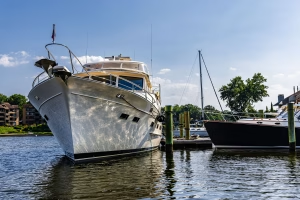
The second half of the law creates a brand-new section, Md. Code, Nat. Res. § 8-720.1, giving titled vessels the same tool. A sole owner, or co-owners holding as joint tenants with right of survivorship or tenants by the entirety, can apply to the Department of Natural Resources to designate a beneficiary who takes ownership at the death of the sole owner or the last surviving co-owner. The mechanics mirror the vehicle statute point for point: the TOD notation on the title, full lifetime control, revocability without the beneficiary’s consent, the beneficiary’s application for a new title with the original certificate and death certificate, and reversion to the estate if the beneficiary does not survive.
For Maryland families this matters more than it might elsewhere. Boats are common assets here, they are titled property just like cars, and they have been a recurring reason estates get opened for no other purpose. As of October 1, a boat can be pointed directly at the person who is supposed to inherit it. And this change arrives alongside an even bigger one: the same legislative session gave Maryland transfer-on-death deeds for real property, meaning the house, the car, and the boat can now all pass outside probate through the same basic mechanism.
Why this small law matters
In a well-built estate plan, the house, the accounts, and the insurance all pass outside probate, and a car or boat is frequently the only thing left that would require opening an estate. Maryland probate is manageable, but it involves filings, deadlines, probate fees, and months of administration, which is a lot of process for one vehicle. Adding TOD designations to every titled vehicle and vessel is a cheap, quick step that can spare a family the entire exercise. It is now on our standard checklist alongside beneficiary reviews, and worth doing the same week you update the rest of your plan.
The fine print worth knowing
- Creditors are not cut off. Both statutes expressly preserve the rights of the owner’s creditors against the beneficiary (Transp. § 13-115(h); Nat. Res. § 8-720.1(h)). A TOD designation moves the asset outside probate; it does not put it beyond lawful claims.
- Liens survive too. A beneficiary generally takes the vehicle subject to any existing lien, which must be satisfied or released before the title changes hands.
- Inheritance tax can still apply. Passing outside probate is not the same as passing tax-free. Transfers to close family (spouse, children, grandchildren, parents, siblings) are exempt from Maryland inheritance tax, but a TOD transfer to a niece, nephew, or friend can still trigger the 10 percent tax.
- Name a backup plan. If the beneficiary dies first, the asset falls back into the estate. Keep designations current after deaths, divorces, and falling-outs, and make sure the will covers the asset as a backstop.
- Coordinate with the rest of the plan. A TOD designation overrides whatever the will says about that asset. If the will leaves “my truck” to one child and the title names another, the title wins, and the family conflict that follows costs far more than the truck.
Frequently asked questions
Can I put a beneficiary on my boat title in Maryland?
Yes, as of October 1, 2026. A sole owner, or co-owners with right of survivorship, can apply to the Department of Natural Resources to designate a transfer-on-death beneficiary under new Nat. Res. § 8-720.1.
Can a married couple name a TOD beneficiary on a jointly titled car?
Yes, starting October 1, 2026, if they hold the vehicle as joint tenants with right of survivorship or tenants by the entirety. The vehicle passes to the surviving spouse first, then to the named beneficiary at the second death, outside probate both times.
Does a TOD vehicle designation avoid probate in Maryland?
For that asset, yes. The vehicle or vessel passes directly to the surviving beneficiary and is not part of the probate estate, so no letters of administration are needed for the transfer. If the beneficiary predeceases the owner, however, the asset falls back into the estate.
Can I change or remove the beneficiary later?
Yes. The designation can be revoked or changed at any time before death by applying to the MVA (or DNR for a vessel), without the beneficiary’s knowledge or consent, and the owner remains free to sell the asset outright.
Beneficiary designations only work when they are coordinated: titles, deeds, accounts, and the will all pointing the same direction. The Law Office of Maxwell White helps Maryland families build estate plans where nothing slips through to probate by accident. Reach out for a consultation to review yours.
This article is general information about Maryland law, not legal advice, and it should not be relied upon as a substitute for advice from a licensed attorney about your specific situation. Reading it does not create an attorney-client relationship with The Law Office of Maxwell White, LLC. Statutory details and MVA and DNR procedures can change. Before adding or relying on a beneficiary designation as part of your estate plan, speak with an attorney about your circumstances.