




Maryland’s New Transfer-on-Death Deed: Pass Your Home Without Probate
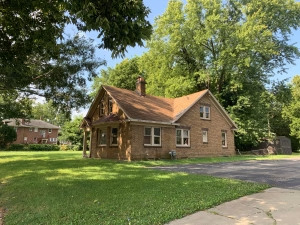 For most Maryland families, the home is the single largest asset they will ever pass on, and until now, passing it on has meant one of three things: probate under a will, the cost of a revocable living trust, or the rigidity of a life estate deed that cannot be undone without the beneficiary’s cooperation. Most other states added a fourth option years ago. Maryland finally has it too.
The Maryland Transfer-on-Death Deed Act (HB 738/SB 651, signed May 26, 2026) takes effect October 1, 2026, creating a new Subtitle 10 of Title 14 of the Real Property Article (Real Prop. §§ 14-1001 through 14-1014), with companion changes to the Estates and Trusts and Tax-Property Articles. It lets a property owner record a simple, revocable deed today that passes the property directly to a named beneficiary at death, with no probate required for that asset. The legislation is based on the Uniform Real Property Transfer on Death Act adopted across most of the country, and it passed the General Assembly without a single opposing vote. It is the most significant change to Maryland estate planning law in years, and it deserves a careful look at both what it does well and where it can go wrong.
What a transfer-on-death deed is
A TOD deed is a deed you sign and record now that has no effect until you die. During your lifetime, nothing changes: you remain the full owner, you can sell the property, refinance it, rent it, or mortgage it, and the beneficiary has no interest in it whatsoever. The beneficiary’s consent is not required, they do not need to be notified, and no money changes hands. At your death, if the deed is still in place and the beneficiary survives you, title passes to them directly, outside probate.

Crucially, the deed is revocable at any time. No one, including the named beneficiary, can prevent you from changing your mind. That is the feature that separates a TOD deed from the life estate deed Maryland families have long used for the same purpose: once a traditional life estate deed is recorded, the remainder beneficiaries own a vested interest, and unwinding it, or selling or mortgaging the property, generally requires their signatures. A TOD deed gives you the probate avoidance without giving up control.
The requirements for a valid TOD deed
The Act sets out a short but unforgiving list of requirements. A TOD deed that meets all of them transfers the property automatically at death; a deed that misses any one of them may transfer nothing. Here is each requirement, with its statutory citation:
1. The owner must have capacity. The capacity required to make (or revoke) a TOD deed is the same as the capacity required to make a will (§ 14-1004(c)). That is a meaningful standard in families dealing with dementia: a deed signed by an owner who no longer understands what they own and who their natural beneficiaries are is vulnerable to challenge, exactly like a late-life will.
2. The deed must satisfy ordinary Maryland deed requirements. A TOD deed must comply with Real Prop. § 4-101 (§ 14-1005(a)): in writing, signed by the owner, and containing the elements of a valid deed, including a proper legal description of the property. The statutory form is emphatic that a street address alone is not a legal description; the description comes from your current deed, typically the paragraph beginning “Beginning” or “Being.”
3. The deed must say the transfer happens at death. The one substantive sentence the Act adds to ordinary deed law: the deed must state that the transfer to the designated beneficiary is to occur at the transferor’s death (§ 14-1005(b)). Omit it and you have not made a TOD deed; at best you have created confusion about whether you just conveyed your house today.
4. The deed must be acknowledged and properly prepared. The deed must be executed and acknowledged before a notary (§ 14-1011(b)). Like other Maryland deeds, it must also carry a certification that it was prepared by a Maryland attorney or by a party to the instrument (Real Prop. § 3-104(f)), which the statutory form builds in. The form’s notice adds a protective rule: any witnesses and the notary cannot be a relative of any beneficiary or owner.
5. The deed must be recorded before death. This is the requirement that will catch the most people. The deed is effective only if, before the transferor dies, it is recorded in the land records of the county where the property is located (§ 14-1006(a)); property spanning more than one county means recording in each. A signed, notarized TOD deed found in a drawer after death is legally worthless. Note also that the clerk may refuse to record a TOD deed that is not accompanied by a completed intake sheet (Real Prop. § 3-104(g)(6)), so the paperwork at the counter matters too.
What is NOT required. The Act is equally clear about what you can skip: the deed is effective without notice to the beneficiary, without delivery to or acceptance by the beneficiary, and without any consideration (§ 14-1006(b)). The beneficiary never has to know, agree, or pay. And because the Act exempts TOD deeds from the usual requirement that county taxes be paid up before recording (Real Prop. § 3-104(a)(1)), an owner behind on property taxes can still record one.
The Act includes an official fill-in form (§ 14-1011) with plain-language instructions, and one of the law’s stated goals is making the tool accessible without heavy legal cost. But read the form’s own warnings: it says consultation with a lawyer is strongly advised if not all current owners are signing, if your name has changed since you acquired the property, or if you want to name multiple beneficiaries, and that using the form for situations more complex than it was built for “may have unintended consequences.” Getting the legal description exactly right, choosing the form of ownership for multiple beneficiaries, and coordinating with the rest of a plan are precisely where the inexpensive tool becomes expensive.
Changing your mind: how revocation works
Before the deed is recorded, changing your mind is easy: destroy the document. After recording, revocation must happen the same way the deed happened, on the record. Under § 14-1008, you can record a new TOD deed that revokes the old one expressly or by inconsistency, record a formal instrument of revocation (the Act includes a form for this too), or transfer the property during life by a deed that expressly revokes it. What you cannot do once the deed is recorded: tear it up (a “revocatory act on the deed” has no effect, § 14-1008(b)(1)) or revoke it through your will, even a will signed after the deed was recorded (§ 14-1008(b)(2)). A will that says “I leave the house to my daughter” does not defeat a recorded TOD deed naming your son. And where joint owners made the deed together, it is revoked only if all living joint owners revoke it (§ 14-1008(c)).
Two revocations happen automatically, whether you think about them or not. The Act incorporates Maryland’s rules on revocation by changed family circumstances (§ 14-1009(a), applying Est. & Trusts § 4-105(b)(3) and (4)): a TOD deed naming your spouse is revoked by a later absolute divorce or annulment, and a TOD deed can be revoked if you later marry and have a child with your new spouse. The same section also subjects TOD deeds to the surviving spouse’s elective share, the statutory share of an omitted child, the slayer rule, and Maryland’s simultaneous death rules. In other words, a TOD deed does not float free of family protection law; it sits inside it, which is one more reason these deeds belong inside a coordinated plan rather than alongside one.
What the beneficiary actually receives
The beneficiary takes the property subject to everything attached to it at death: the mortgage, liens, leases, and other encumbrances all come along. A TOD deed transfers title, not a clean slate. If the beneficiary dies before the owner, their interest lapses, though the Act allows alternate beneficiaries to be named in succession, which a well-drafted deed should include. Where multiple beneficiaries are named, the statutory form transfers to them as joint tenants with right of survivorship, a default that is not right for every family and can be changed with proper drafting. The deed also transfers the property without any covenant or warranty of title (§ 14-1009(c)), so the beneficiary takes title as-is. And for property already co-owned with survivorship rights, such as a married couple’s home, the statute is explicit: if the transferor is survived by another joint owner, the property simply belongs to the survivor, and the TOD deed takes effect only at the death of the last surviving joint owner (§ 14-1009(e)). After the death, the transfer is automatic, but the Act provides an optional notification-of-death form the beneficiary can record to update the land records and assessment rolls (§ 14-1013), which in practice every beneficiary should do.
The tax picture
The Act exempts a TOD deed from recordation tax when the property is a primary or secondary residence of the transferor (Tax-Prop. § 12-108(ii)), and matching provisions exempt it from state and county transfer taxes (Tax-Prop. §§ 13-207(a)(27), 13-414), which removes what would otherwise be a meaningful upfront cost for most homeowners. But do not confuse recording-tax relief with inheritance-tax relief: the statute’s own FAQ says plainly that a TOD deed does not help avoid inheritance taxes. Transfers at death to a spouse, children, grandchildren, parents, or siblings are exempt from Maryland inheritance tax anyway, but a TOD deed to a niece, nephew, partner, or friend can still trigger the 10 percent tax, and because the property passed outside probate, the tax obligation can catch the recipient off guard. Federal and Maryland estate tax treatment also does not change: the property remains part of the taxable estate, which for most families is actually good news, because it means the beneficiary should receive a stepped-up income tax basis. Tax treatment depends on your facts, and this is one of the areas to review with an advisor before recording anything.
When a TOD deed is the right tool, and when it is a trap
Where it shines.  The classic fit is a widowed parent with one home, a modest estate, and adult children who get along: the TOD deed passes the largest asset cleanly, the rest of the plan handles the remainder, and the family avoids probate on the house for the cost of one recorded document. Paired with the new TOD designations for vehicles and boats and standard account beneficiaries, a straightforward estate plan can now route every major asset around probate. It is also a genuine public good for families vulnerable to tangled titles, where a home stuck in an unopened estate can spiral into tax sale; advocates for exactly those homeowners were among the bill’s strongest supporters.
Where it backfires. A TOD deed is a blunt instrument. It cannot hold property for a minor or manage it for a beneficiary with special needs, where an inheritance received outright can destroy public benefits eligibility. It provides no management if you become incapacitated, which a funded trust does. It does not handle blended-family tradeoffs, such as providing for a second spouse for life and children from a first marriage afterward. Naming multiple children on a deed can hand them a co-owned house and a built-in dispute. Long-term care is its own analysis: the Act says that during the owner’s lifetime a TOD deed does not affect the transferor’s or the beneficiary’s eligibility for any form of public assistance (§ 14-1007(4)), but what happens at death, including Medicaid estate recovery, is a separate question the statute does not answer, and anyone planning around nursing home costs should get specific advice before relying on one. Courts are also directed to interpret the Act in harmony with Maryland’s existing law on life estate deeds with powers, so if you recorded a life estate deed in years past, it is worth having it reviewed alongside the new option.
Already recorded a TOD deed? The retroactivity rule
The Act applies to TOD deeds made before, on, or after the effective date, so long as the owner dies on or after October 1, 2026. A deed recorded in anticipation of the law is not wasted, but it will be judged under the Act’s requirements, which is a good reason to have any early deed reviewed for compliance now, while it can still be fixed.
Frequently Asked Questions
Does Maryland allow transfer-on-death deeds?
Yes. The Maryland Transfer-on-Death Deed Act (HB 738/SB 651, 2026) takes effect October 1, 2026, and is codified at Real Prop. §§ 14-1001 through 14-1014. It also applies to TOD deeds recorded before that date if the owner dies on or after October 1, 2026.
Does a transfer-on-death deed avoid probate in Maryland?
For the property it covers, yes. Title passes directly to the surviving beneficiary at death without probate administration of that asset. Other assets without their own beneficiary arrangements still go through probate.
Can I revoke a transfer-on-death deed?
Yes, at any time, without the beneficiary’s consent, by recording a new TOD deed, recording an instrument of revocation, or transferring the property during your lifetime. You cannot revoke a recorded TOD deed through your will.
Is a transfer-on-death deed better than a living trust?
It depends on what you need. A TOD deed is simpler and cheaper for passing a single property outright to capable adult beneficiaries. A trust can manage property during incapacity, hold assets for minors or beneficiaries with special needs, and handle complex family structures. Many plans use one or the other; the wrong choice usually comes from not asking the question.
Does the beneficiary take over the mortgage?
The beneficiary takes the property subject to the mortgage and any other liens or encumbrances that exist at the owner’s death. The debt does not disappear with the transfer.
A transfer-on-death deed is a powerful new option, and like every estate planning tool, it works best when it is chosen deliberately and coordinated with your will, beneficiary designations, and long-term care planning. The Law Office of Maxwell White helps Maryland families decide whether a TOD deed fits, prepares and records deeds that comply with the new Act, and reviews existing life estate deeds under the new rules. Call (443) 647-9009 or schedule a consultation.
This article is general information about Maryland law, not legal advice, and it should not be relied upon as a substitute for advice from a licensed attorney about your specific situation. Reading it does not create an attorney-client relationship with The Law Office of Maxwell White, LLC. The Maryland Transfer-on-Death Deed Act is new, and its details, forms, and interaction with tax and benefits rules may be refined over time. Do not record, revoke, or plan around a transfer-on-death deed without speaking to an attorney about your circumstances.