


Per Stirpes vs. Per Capita at Each Generation: The Complete Explainer
Two pieces of Latin buried in your will control one of the biggest questions in inheritance: if a child dies before you, what happens to their share? Most people sign documents containing “per stirpes” or “per capita” (or per capita at each generation) without ever learning what they chose, but the difference can move tens of thousands of dollars between grandchildren.
This guide is the reference we wish every client had: plain English, one running example, diagrams, and a chart. Bookmark it.
The Question These Terms Answer
Imagine you leave your estate “to my children.” Simple, right? Until one of your children predeceases you, leaving children of their own (your grandchildren). Now what?
- Does the deceased child’s share flow down to their kids?
- Or do the surviving members of the family divide differently?
“Per stirpes” and “per capita at each generation” are the two main answers. It’s the same starting family but completely different math.
The Running Example
Meet a parent with three children, Beth, Carl, and Dana, and four grandchildren:
- Beth has one child (B1) — Beth predeceases the parent
- Carl has three children (C1, C2, C3) — Carl predeceases the parent
- Dana has no children and survives
The estate is $300,000. Watch how each rule splits it.
Per Stirpes (“By the Branch”)
Per stirpes is Latin for “by the roots” or “by the branch.” Each child’s branch of the family tree gets an equal share, and a deceased child’s share drops down their own branch to their descendants.
The math: three branches, $100,000 each.
- Dana (alive): $100,000
- Beth’s branch: her $100,000 passes entirely to B1 → $100,000
- Carl’s branch: his $100,000 splits among his three kids → C1, C2, C3 get $33,333 each
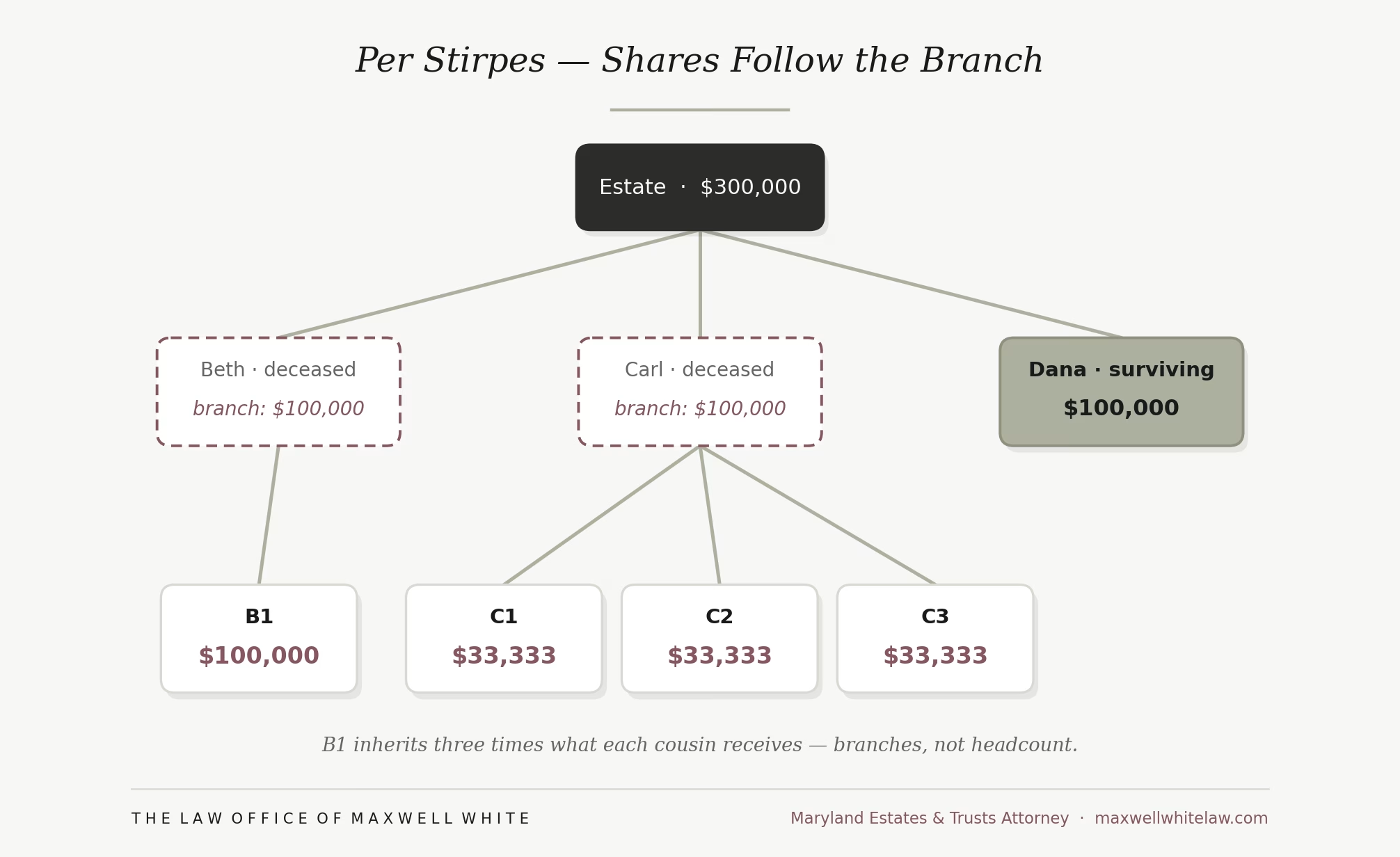
The result: B1 gets $100,000 while cousins C1–C3 get $33,333 each. Grandchildren in the same generation receive different amounts, purely because of how many siblings they have.
Per Capita at Each Generation (“Equally Near, Equally Dear”)
This rule starts the same way — but pools the dropped-down shares so that everyone in the same generation receives the same amount.
The math: Dana takes her $100,000 first. The two deceased children’s shares ($200,000) are combined and divided equally among all four grandchildren: $50,000 each.
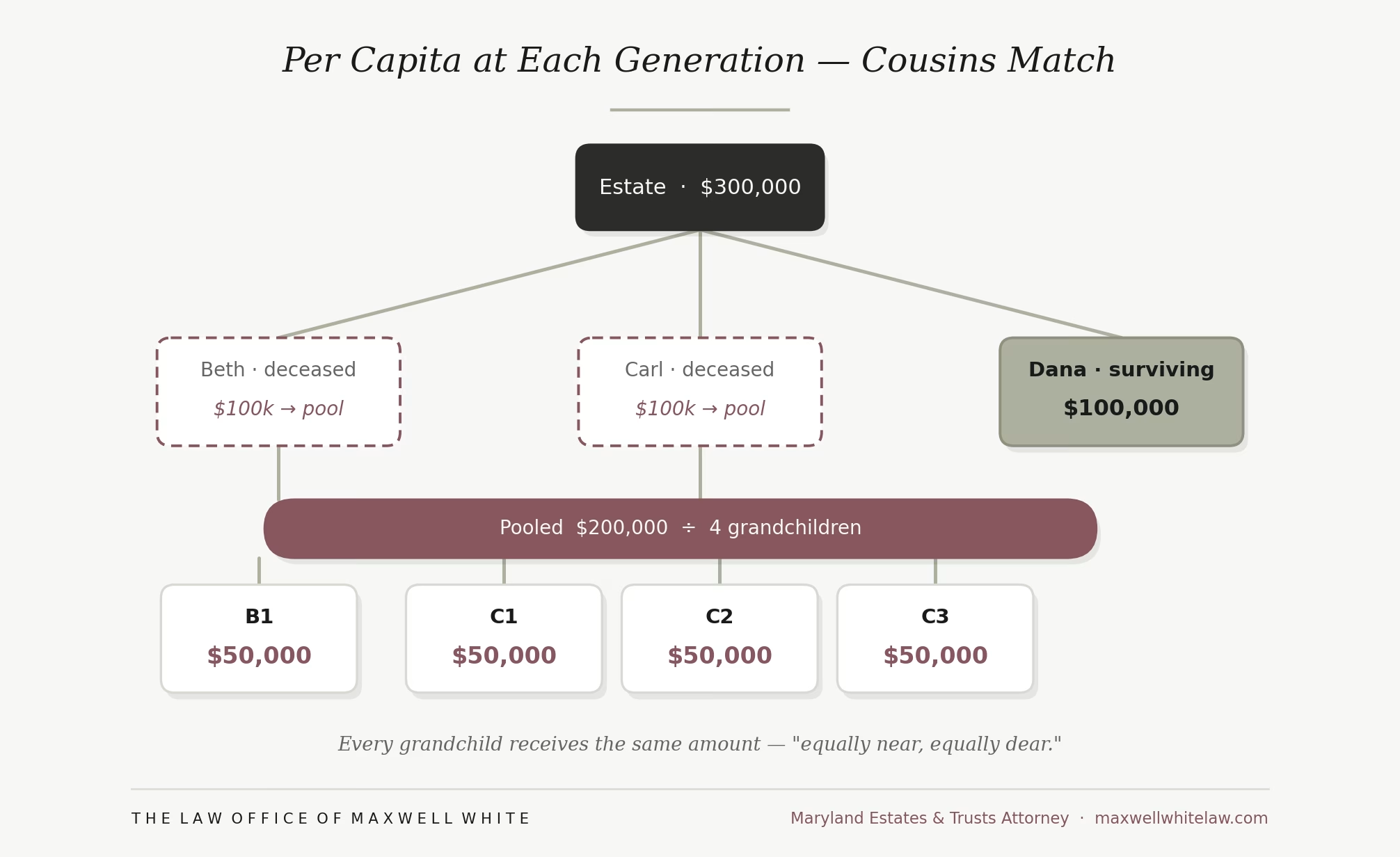
Side-by-Side: The Same Family, Two Outcomes
| Heir | Per Stirpes | Per Capita at Each Generation |
|---|---|---|
| Dana (surviving child) | $100,000 | $100,000 |
| B1 (Beth’s only child) | $100,000 | $50,000 |
| C1 (Carl’s child) | $33,333 | $50,000 |
| C2 (Carl’s child) | $33,333 | $50,000 |
| C3 (Carl’s child) | $33,333 | $50,000 |
Notice what doesn’t change: surviving children are unaffected. The rules only diverge when two or more branches drop down with different numbers of descendants.
Which Should You Choose?
There’s no “correct” answer. It’s all about your personal philosophy. There’s only the answer that matches your values.
Choose per stirpes if you think in branches. “Each of my children’s families gets an equal slice, however they pass it on.” It mirrors how property would have flowed if every child had survived and then left their estate to their own kids. It’s also the traditional default in many documents. This approach favors kids with fewer siblings, because they don’t have to split their parent’s share with any siblings.
Choose per capita at each generation if you think in people. “I love all my grandchildren equally, and I don’t want one to inherit triple another because of family size.” If you picture the grandchildren comparing notes at Thanksgiving, this is the rule that avoids the awkward conversation.
Three Practical Warnings
- Plain “per capita” (without “at each generation”) is a different, harsher rule that can disinherit a deceased child’s descendants entirely in some formulations. The exact phrase matters (another reason DIY drafting goes wrong.)
- Beneficiary designation forms use these terms too. Your 401(k) form may offer a per stirpes checkbox. If your will says one thing and your forms another, your plan contradicts itself.
- If you have no will, you don’t get to choose. Maryland’s intestacy statutes apply their own representation rule, which is the state’s values, not yours.
Frequently Asked Questions
What does per stirpes literally mean?
“By the roots” or “by the branch” in Latin. Each branch of your family tree takes one share, and the share follows the branch downward.
Do these rules matter if all my children outlive me?
No. They only activate when a beneficiary predeceases you leaving descendants. But since no one can guarantee the order of deaths, every well-drafted plan answers the question in advance.
Can I use different rules for different gifts?
Yes. Documents can apply one rule to one gift and another elsewhere, though consistency usually serves families better and reduces confusion.
Not sure which two words are sitting in your will or what they’d actually do to your family? Bring it in and we’ll walk the branches together. Call The Law Office of Maxwell White at (443) 647-9009 for a free consultation.